

What was the world’s first phonecard? The question may seem straightforward, but the historical evidence points in several directions at once. In this article, Eric Schuenemann, founder of the Phonecard Museum and WPC Club Official Cultural Partner, traces the earliest prepaid telephone cards, from the first prototypes of the early 1970s to the cards that changed public telephony forever.
The Story of the World’s First Phonecard
The Electrical Telegraph was the first major electrical telecommunications system, most commonly used from the 1840’s until the early 20 th century to deliver TEXT messages (like really old SMS).
Communication time was reduced from weeks to mere MINUTES! Prepaid vouchers or stamps, to pay for these services became commonplace.
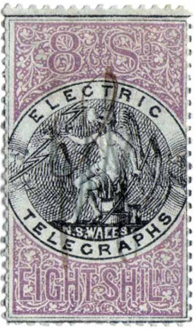
Telegraph stamp 8 shillings 1871
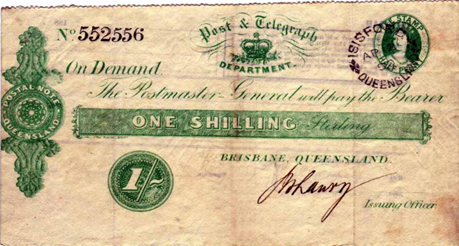
1880 postal note REVERSE prepaid telegram voucher
Telegraph credit cards and passes were common in USA during the 1800s, but soon the telephone was to revolutionize communications.
After the invention of the telephone in 1876, the world underwent an intense communications evolution. Public telephones in or near post offices emerged in the late 19th century, with early examples appearing around 1880-1881. Here is shown a telephone call voucher from the late 1800’s
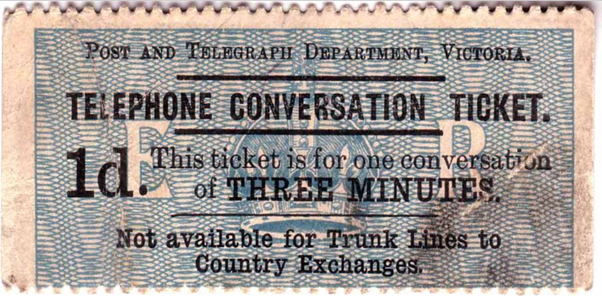
Telephone call voucher from the late 1800s
Telephone stamps became a highly used item, as the demand for making telephone calls increased.
The collecting of these telephone stamps is called Telegraphic Philately.
Actual cards called “Telephone Pass” came into use by the late 1800’s to early 1900’s. We show here an example from 1913. The reverse instructions explain the “Collect Call” nature of the telephone pass.
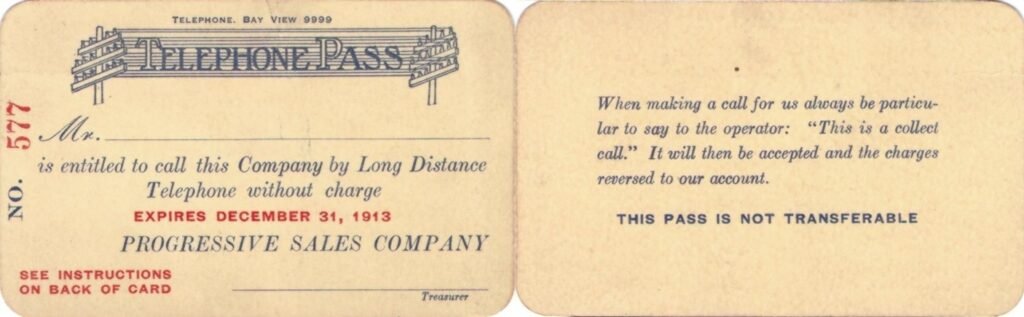
Telephone Pass
During the 1930’s, the USA experienced an explosion of Credit cards in the Oil industry. This method of increasing revenue was soon adopted by the USA telephone companies under the BELL system. By the 1950’s many of these companies were issuing Telephone CREDIT cards
We must make it clear, that the charges arising from these operator connected calls, were deferred to an account, just like any CREDIT card, in contrast to a DEBIT system, and do not qualify as PRE-Paid telephone cards.
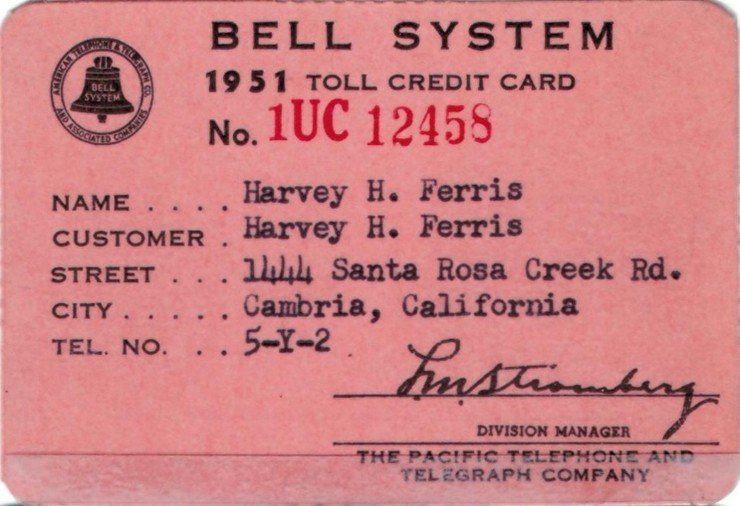
Bell System
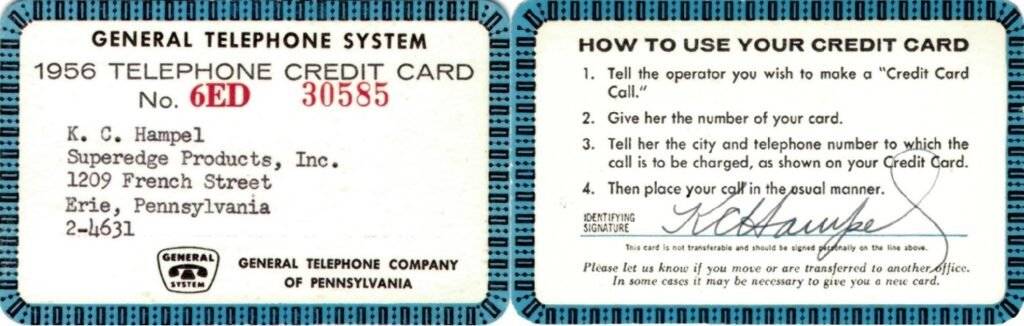
General Telephone Company
Telephone credit cards continued common use in the USA right through to the 1970s. The early 1950’s versions were often named “TOLL” credit cards, and then by the mid 1950’s, “TELEPHONE” credit cards. From about 1980 these type of credit cards were re-named “CALLING” cards.
The question of the world’s first Prepaid Phonecard? Not so simple!
By the early 1970’s, many Telephone companies around the world were keen to find ways to deal with the problems associated with coin operated public telephones. The idea of prepaid cards were already being investigated by 1972-73, or even earlier.
So the question is often asked: what’s the world’s first Phonecard (as a prepaid card)?
The answer to this question will depend on the parameters you set for “world’s first”
We have included 3 types of W1 Phonecard:
W1A: Germany Dusseldorf 1974
W1B: Switzerland Geneva UIT magnetic (Spain) 1975
W1C: Italy SIP Public Use 1976
The simple answer, if you are looking for a PUBLICLY sold PRE-paid card, issued by an official country telecom, it is of course, Italy 1976. But let’s also look at these other VALID world first Phonecards in chronological order.
W1A June 1974 – Germany, Dusseldorf PRESS phonecard (WM74)
For the WELTMEISTER (FIFA World Cup) hosted by the city of Dusseldorf in June to July in 1974, the organisers introduced a revolutionary group of cards operated telephones for the PRESS attending the matches. The cards utilized the popular IBM hole punch technology and were fully inserted into the telephone using the 2 side-hole tracks, which ‘read’ each card’s unique hole positions, before debit calls could be made.
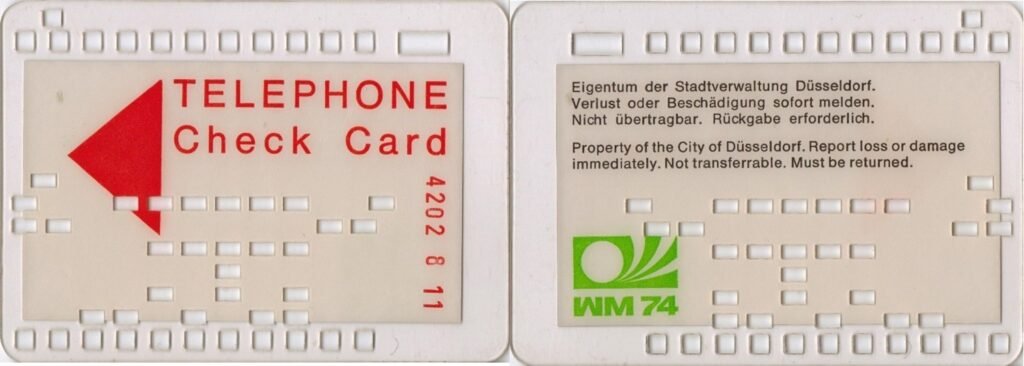
With regard to the Dusseldorf Check card, it is VITAL to note the card’s SELF description in order to distinguish it from the known phone CREDIT cards. This was a “CHECK” card, prepaid, issued with unique serial number for each card. In the age before mobile phones, this card must have made life much easier for the Press attending the tournament. This is the ONLY phonecard of this technology that we are aware of. A unique system in many respects.
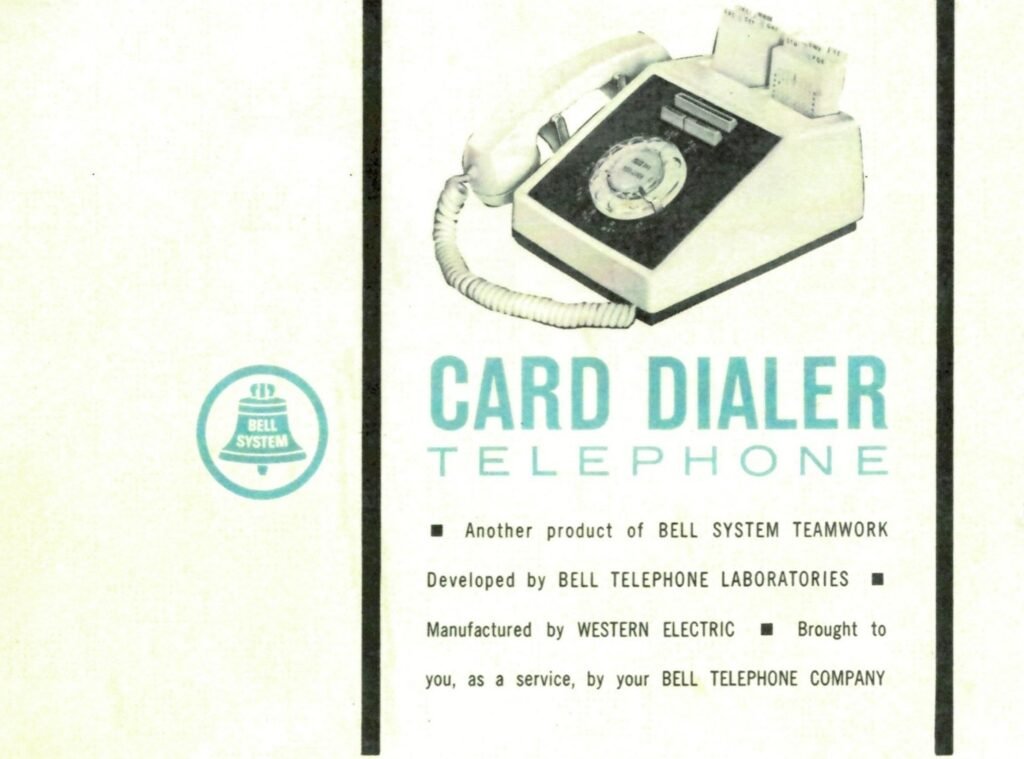
Telephone Dialer card (not a prepaid phonecard)
Please note that a completely different type of “Phone” card was being trialled at the same time, called a Telephone DIALER card. These cards had similar side tracks, but the central holes ONLY corresponded to the actual phone number being dialled and had no prepaid value.
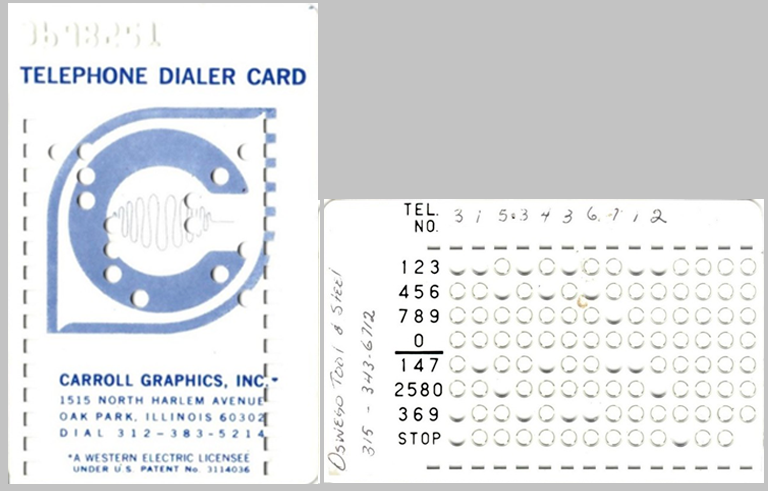
A picture of the original Dialer phone on the Bell laboratories advertising, shows that it was designed for offices and factories as a time saving device for dialling phone numbers without errors.
W1B October 1975 – Switzerland UIT Exhibition Demo-Trial Phonecard L&G Telecom Espana
By 1974, Landis & Gyr were already developing technology devoted to pre-paid optical Phonecards, but the optical system was not ready. L&G were testing the feasibility of Phonecards with the currently used magstripe technology. By 1975, after some internal testing, they were already producing magnetic Phonecards for the telecom of Spain.
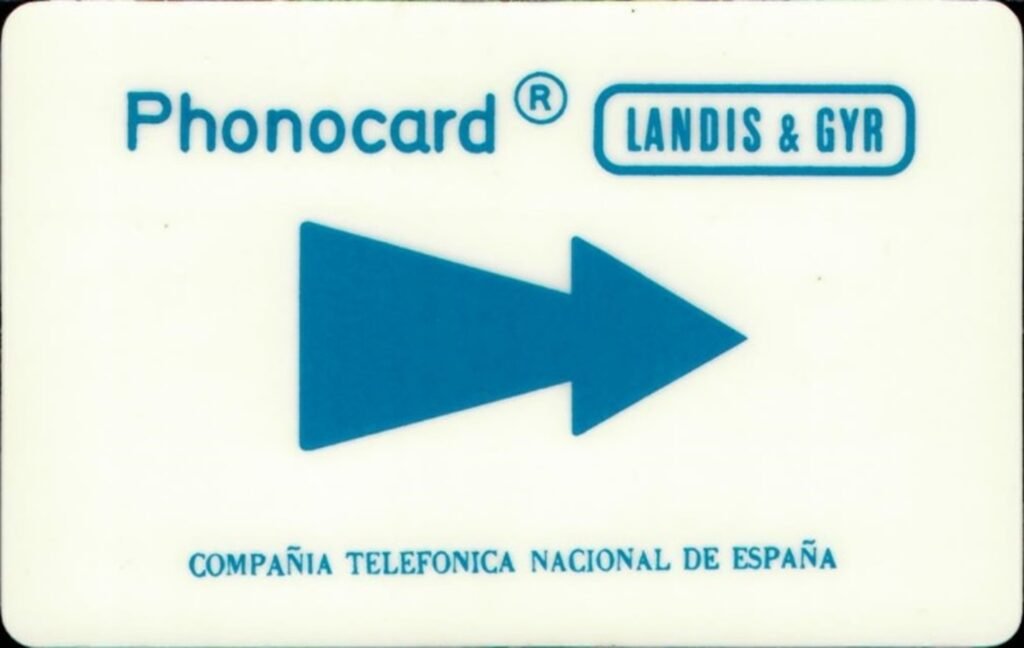
Prior to the implementation of the trial in Spain, L&G set up telephones at the UIT building in Geneva, where the TELECOM conference of UIT was held every 4 years. The first Telecom 71 had received 70,000 visitors. This 2nd Exhibition was October of 1975. The Spanish trial cards were used to make telephone calls at this facility. Visitors to the exhibition were encouraged to try the cards to assess customer reaction.
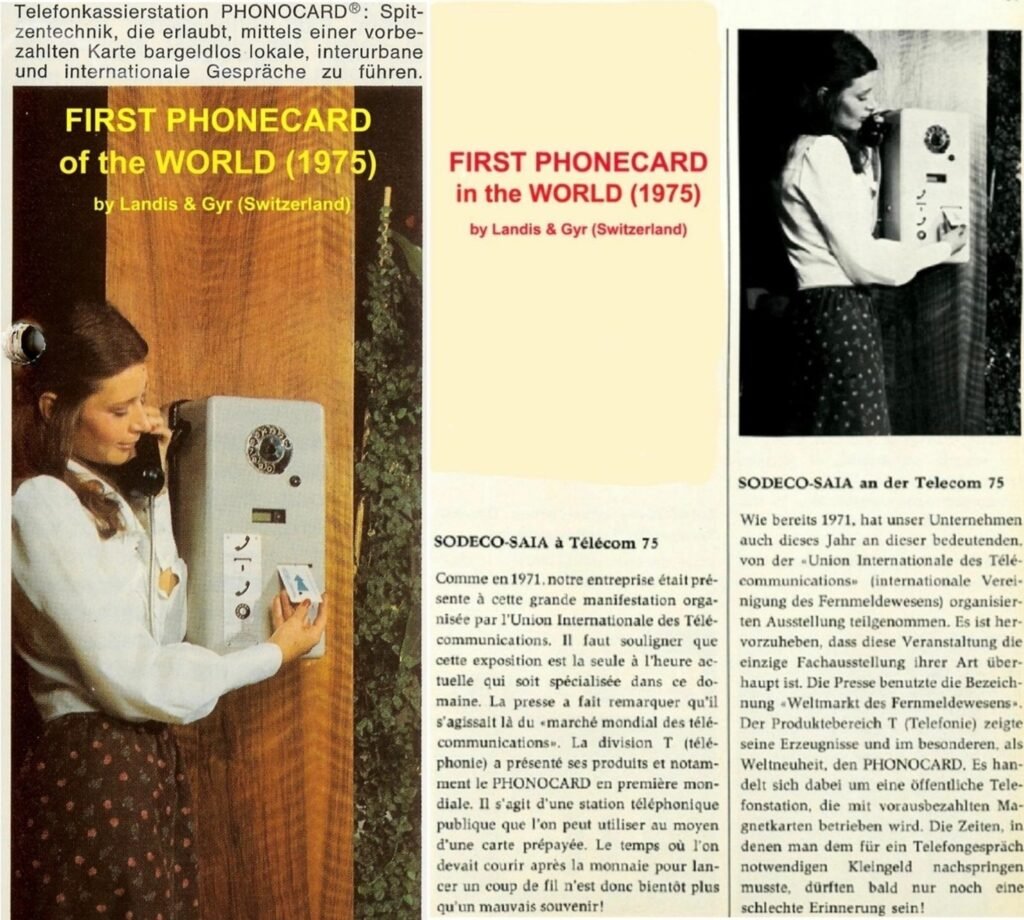
W1B Landis & Gyr phonecard flyer
A special thanks to Alain Knecht for his research about W1B L&G phonecard.
The Spanish magnetic card can be described as the first “Public Exhibition” card but is not in the same category as the Italian SIDA which is a “Public Telecom Field Trial” card.
W1C May 1976 – Italy “SIDA 0” World First PUBLIC TELECOM Phonecard
Prepaid magnetic Phonecards and card payphones were also being developed by the company SIDA in the early 1970’s. The magnetic band was a central across-ways positioned magslurry band, (not a plastic magnetic tape) and the first magnetic coding was in a straight line. The cards were produced in paper, with a thin plastic laminate on the serial number side.
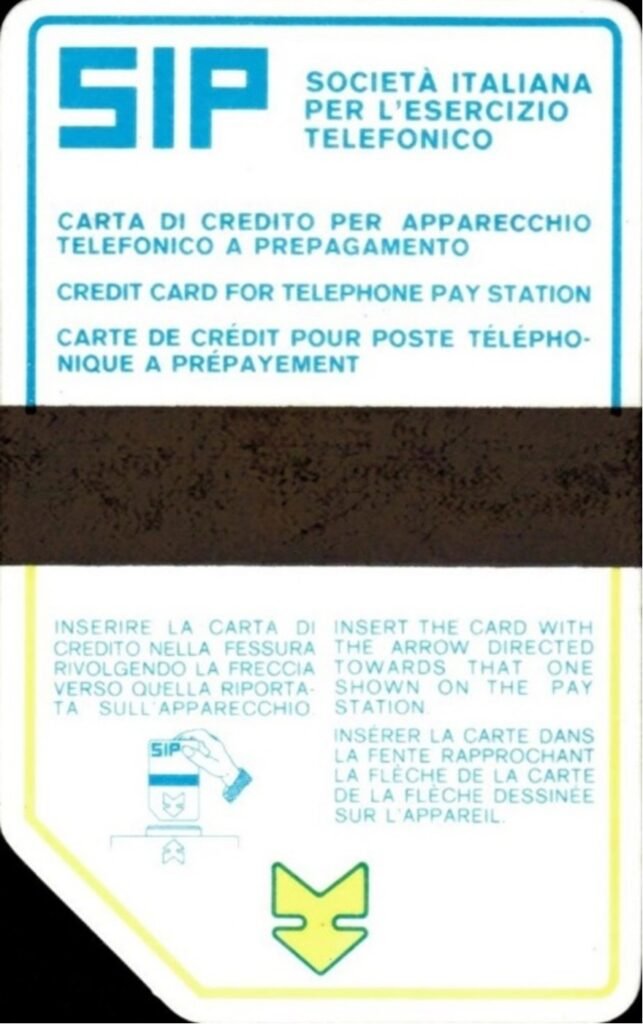
SIDA was accepted for the supply of 25 card telephones initially, and Phonecards for a world first PUBLIC field trial. The most well-known is in the underground car park of the Galoppatoio in Villa Borghese in Rome. The month is May 1976. 25 Cardphones had been delivered, and there may have been around 10 other locations with 1 or 2 phones, for this first field trial, including the Guglielmo Reiss Romoli School in L’Aquila.
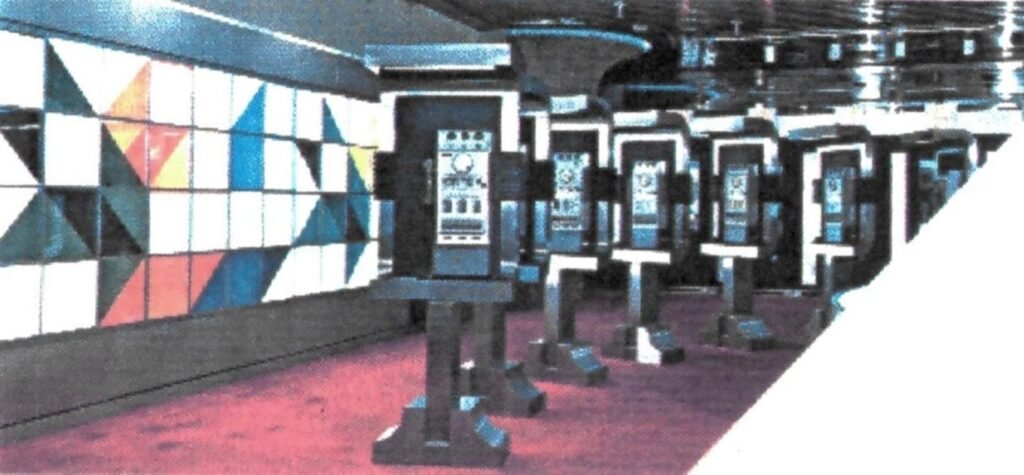
Here is the text in English from an original Galoppatoio publicity leaflet for the SIDA0 Phonecard of 1976 and the photo of the public phone station in the underground parking of the Villa Borghese and a map also from an original publicity leaflet:
“From the AUTOMATIC TELEPHONE STATION that SIP has set up in the Villa Borghese underground parking place, it is possible to call DIRECTLY by direct dialling the subscribers of: – All Italian localities; – The following European countries………. – The following extra-European countries……… In the Villa Borghese AUTOMATIC TELEPHONE STATION there are token, and 50 and 100 lire change telephone and the new magnetic card telephones. In the station, there is a permanent telephone show.”
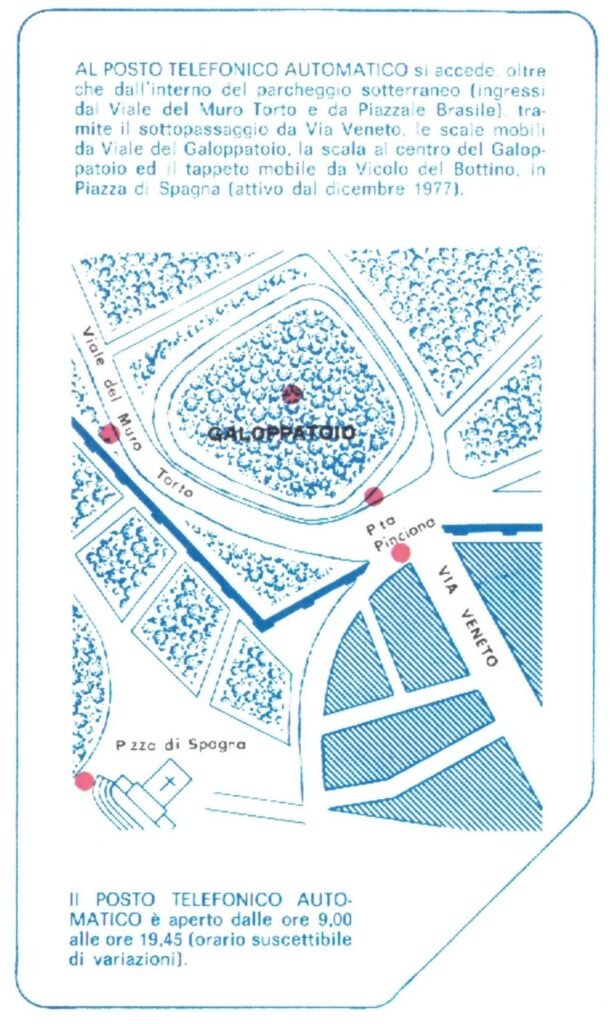
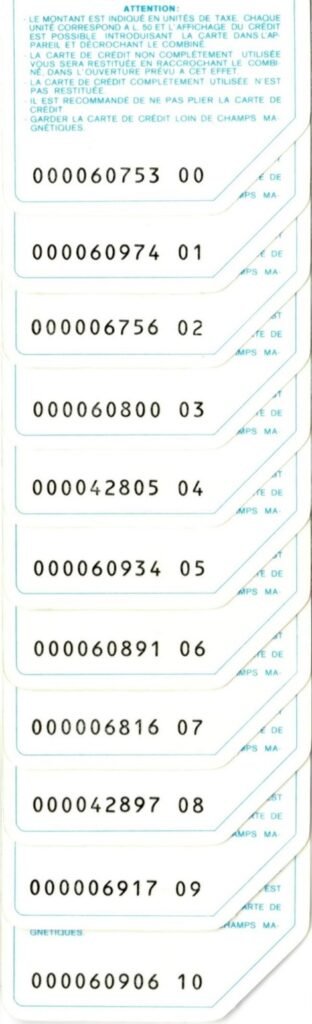
Here is the Galoppatoio map, and a scan of the print sheet serial suffixes.
A special thanks to Lee Mastrogiuseppe for his research on coding.
SIDA 0 was produced in a quantity approaching 300,000 cards with 11 different two-digit sheet cycle suffixes. These were manufactured with the flimsy material, and magnetic coding, and the vast majority of the production were destroyed. It is also reported that the phones retained the used cards, which were collected by specially employed staff to return the used cards for study and supervised destruction.
These cards very rarely come up in the market now, and most are deeply embedded in collections.
Laboratory testing of a new ARC magnetic coding began using these cards, in preparation for upgrading of the Phonecard security and a more robust functionality using plastic cards and better magstripe.
SIDA 0 also are found with 5-point star shaped punches of either 1, or 3 punch holes near the SIP logo. These were done by engineers.
This year at PIM 2026 Torino, we celebrate the 50th year since the introduction of the Italian world first public prepaid Phonecards. There will be some special things planned for this historic occasion. Stay tuned!
