

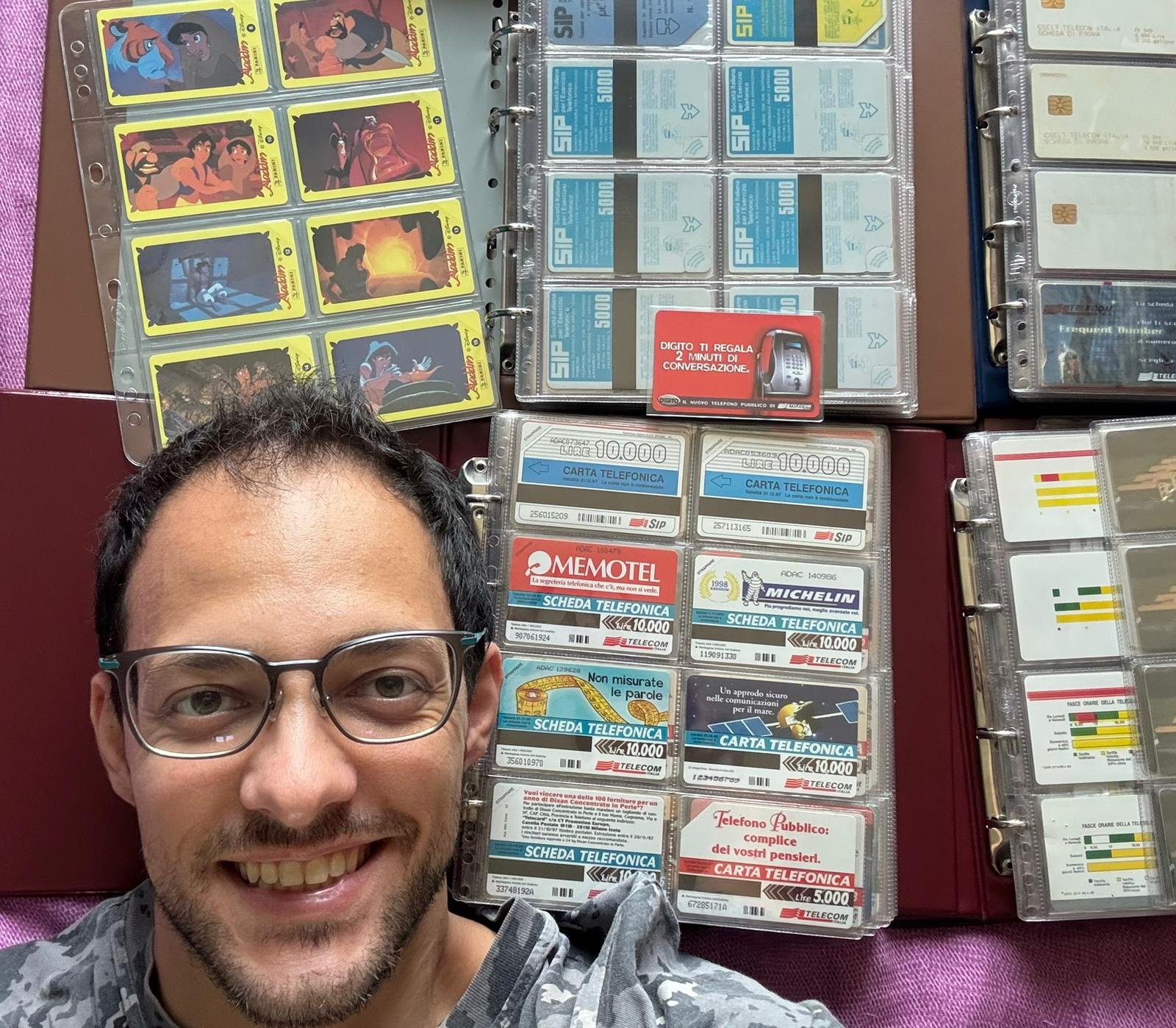
Our Collector Stories series continues with Andrea Franzoni, an Italian collector whose passion began in an unexpected place: a hospital corridor, in 1998. He never stopped, and today, 28 years later, he looks after around 12,000 Italian phonecards.
His is a precise and personal collection, devoted entirely to Italy, with a preference for the most elusive categories: prototypes and printing errors. But behind the numbers there is, above all, a network of people, fellow collectors, former employees and experts who had seen the cards come to life. It was from them that Andrea learned, and it is thanks to that shared knowledge that, together with a team, he co-authored two Golden catalogues. We asked him to tell us how it all began, and what still keeps him tied to this world after all these years.
Article Contents
How many years have you been collecting phonecards and how did this passion start? Is there a specific moment you remember, a first card, or an encounter that changed everything?
My first encounter with the phonecard seen in a different light happened in 1998, in a hospital. My mother was in the middle of a phone call when a nurse approached her and asked whether, once the call was over, he could have the used-up card.
Curious, she asked a few questions, then asked me whether I wanted to keep it or whether she could give it to the man. I already had a few symptoms of the hoarder in me, and my hesitation in answering that apparently simple question was interrupted by the nurse, who put a bundle of 15-20 cards in my hand in exchange for my mother’s.
There was the Telecom dawn, the green aeroplane, a few spinning tops. From that moment on I simply never stopped: gathering them, swapping them and eventually buying them at flea markets, at fairs, from strangers on the pavement and from newsstand owners who kept binders of used cards “under the counter”. I didn’t stop even during high school, so today it has been about 28 years that I have been collecting them.
How would you describe your collection to someone who knows nothing about this hobby? Do you have a specialisation, a favourite geographical area or theme?
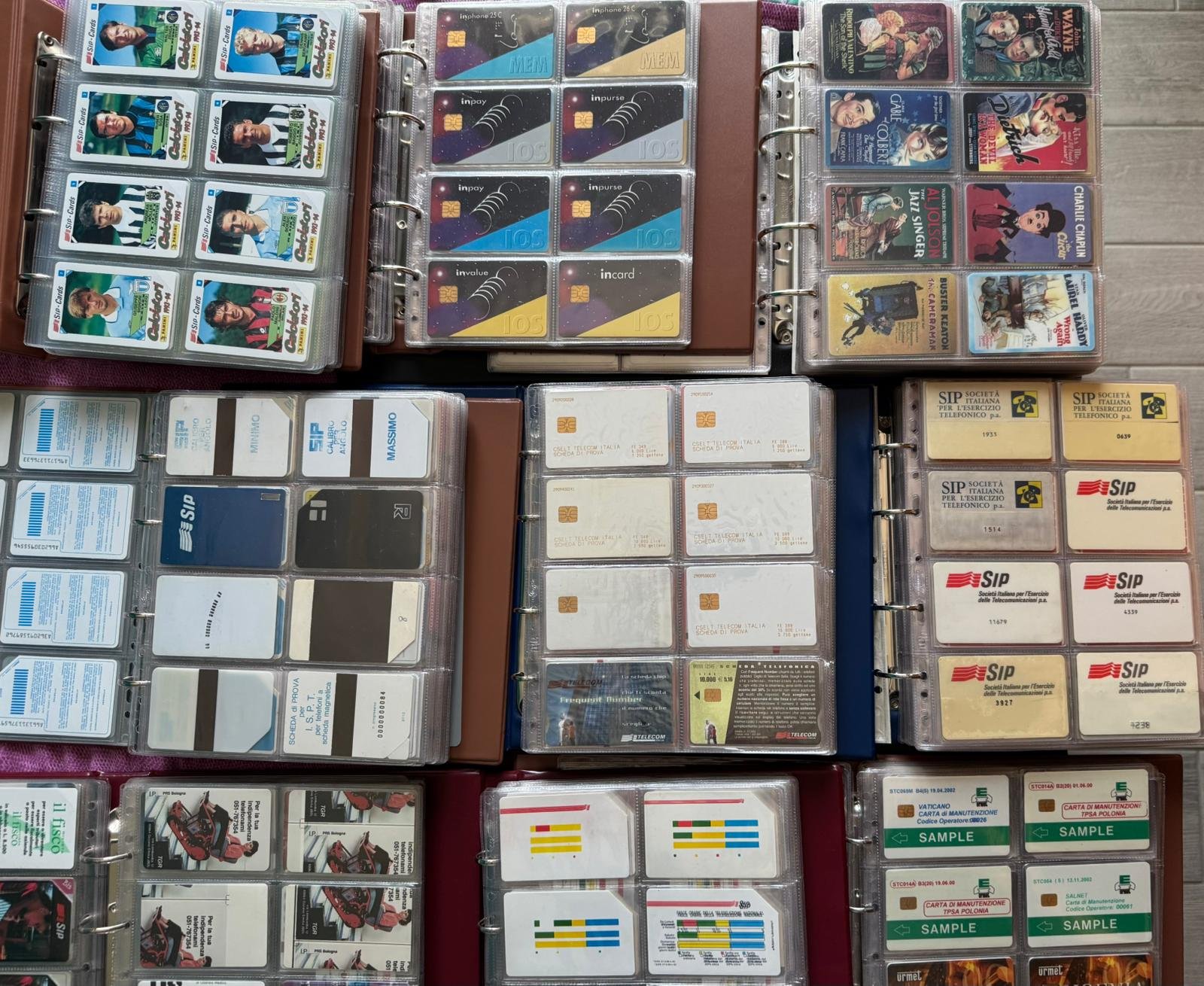
Mine is a collection of Italian phonecards, fairly advanced, with particular attention to the categories of prototypes and printing errors. It is a varied but orderly collection, which includes every type of card produced on behalf of SIP and Telecom and by the other satellite companies.
Approximately how many phonecards do you have in your collection? And over how many years have you built it?
Numerically I should have around 12,000 pieces, all Italian cards, gathered over these 28 years of passion, but above all since 2008, when I began to have my own financial independence.
Is there a card you would never give up? What makes it so special to you?
As a rule I try never to part with pieces from the collection, although it has happened a few rare times, on the occasion of particularly favourable swaps and for cards that are rare but not impossible to find. There are several cards that hold a particular value, beyond the monetary one: perhaps because they come from a fellow collector or from an enthusiast who is no longer with us, or because they are quite rare, seen even just once, and I would not know how or where to find them again.
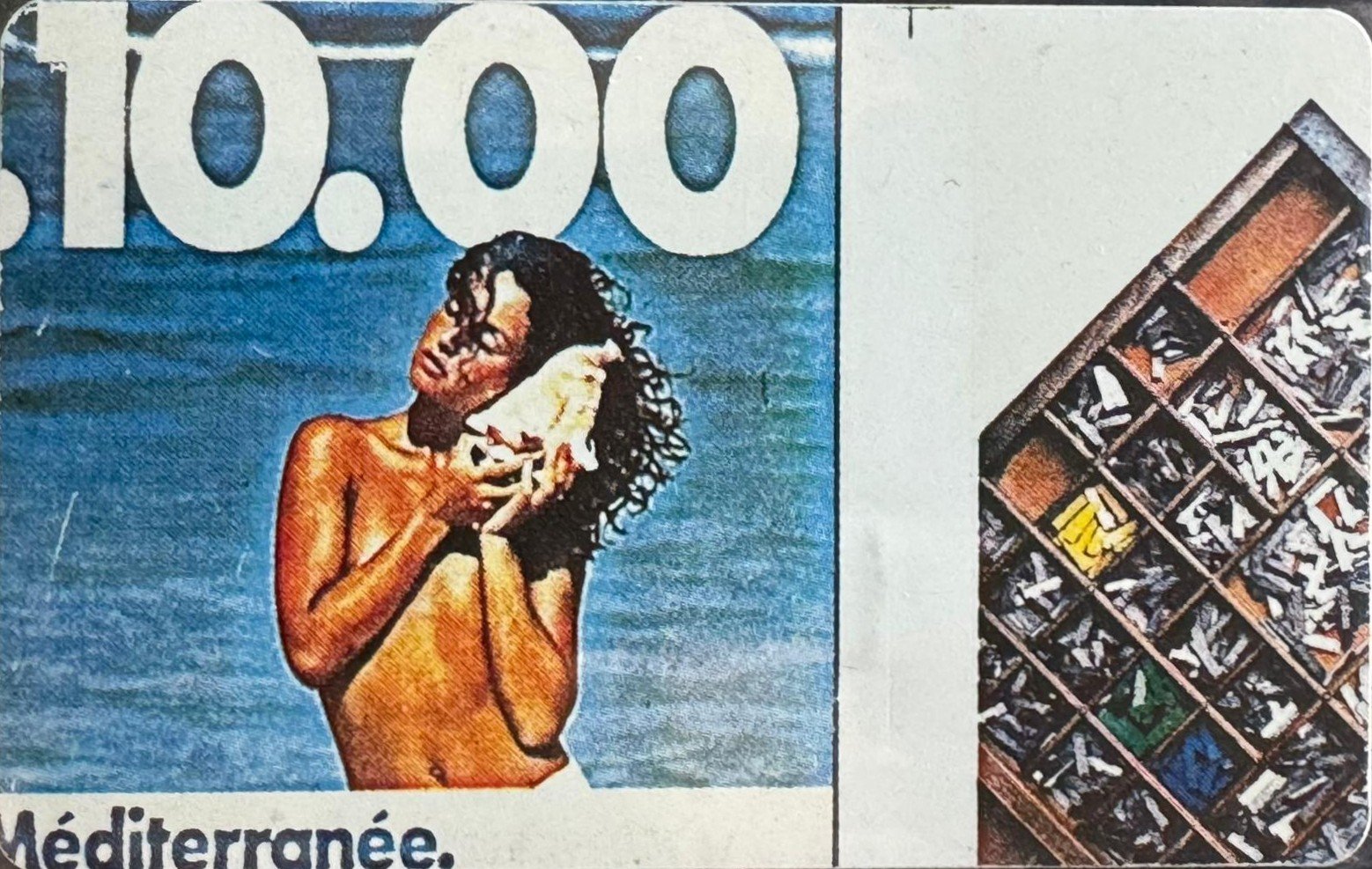
Those I would never think of giving up, as long as I remain a passionate collector. The basic rule stays the same: you do not touch the collection. One card in particular plays a fundamental role: two prototypes printed together and die-cut, with the image split in half across the card. It is a beautiful, valuable card, and it comes from an important negotiation with a person who mattered a great deal to me in the world of collecting.
What gives you the most satisfaction in this hobby: the search, the discovery, the history behind the cards, the contact with other collectors, or something else?
I enjoy the search and the exchange of views, the sorting and the discovery of new pieces or new details. And knowing that there are so many other collectors helps you feel stronger and keeps the passion alive.
Have you ever made an unexpected discovery? A card found by chance that turned out to be particularly rare or significant?
The first one that comes to mind is an Urmet test card, bought within a block of other similar prototypes, which turned out to be a Vatican trial with a print run of only 5 pieces.
Have you attended PIM – Phonecards International Meeting? If so, what do you remember about that experience? If not, is it something you would like to do?
I attended the very first edition of PIM, in Novegro, and I remember that, despite the modest turnout, I had a good time. Above all it was satisfying to see so many tables of nothing but phonecards, something that does not happen at other fairs and markets.
How did you find out about the WPC Club and what convinced you to join?
I got to know the WPC Club through Davide Gambardella, who explained its goals to me and the importance of lending a hand to an association that still cares about giving collectors a face, and that organises an exclusive event dedicated to phonecards.
Is there something you expect from the WPC Club community that you haven’t yet found elsewhere?
In the difficult context in which it operates, I think it has already achieved enviable results.
Is there anything about your collecting story that you would like to share, and that the previous questions didn’t allow you to tell?
My collecting took a turn thanks also to news, advice and finds that came from spending time with experts, “senior” collectors, former employees, dealers and other leading figures of an era in which material and information travelled more slowly but more reliably, with fewer distortions, with more willingness to teach and to share, and with a more lasting enthusiasm.
Perhaps because that enthusiasm came, in turn, from direct experience with people who had seen the cards come into being, had worked on them, had truly used them a great deal, and had a vision that went beyond that of a collector.
What I learned and what I lived will remain part of me forever, and I will also remember, with a touch of nostalgia, those wonderful years of collecting and fun that made me long for Sunday mornings at the flea market, waiting for a new adventure. More recently I wrote and published, together with a team, two Golden catalogues, which have certainly helped to broaden knowledge and to strengthen my bond with the collection.
From his mother’s used-up card in a hospital to the two prototypes die-cut together, Andrea’s story tells us something that goes beyond the 12,000 pieces in his collection. It speaks of a discipline (you do not touch the collection) and, above all, of a bond with people: the experts, the former employees and the collectors who taught him to read a card not only as an object to gather, but as evidence of an era. With his two Golden catalogues, he is now the one giving that knowledge back to the community.
This is exactly what the Collector Stories series sets out to highlight: behind every collection there is a person, and behind every person a story. If you too are a WPC Club member with a collection to share, write to us: you could be the next voice in Collector Stories.
