

The contest results for the design of the WPC Club 2026 Membership Card are in, and they exceeded every expectation. More than 2,000 votes were cast in total, making this the most participated creative initiative in the short but intense history of the Worldwide Phonecards Collectors Club. The contest results confirm what the WPC Club community demonstrates at every edition of the PIM: a passion for phonecards that goes far beyond collecting, extending into creativity, design and cultural contribution.
Article Contents
A Creative Challenge for the Phonecard Community
The Contest Membership Card 2026 was conceived as an opportunity for the WPC Club community to shape one of the association’s most symbolic objects: the official numbered Membership Card issued each year exclusively to WPC Club members.
The context made the challenge particularly significant. The 2026 Membership Card coincides with the 50th anniversary of the first phonecard, making the design brief not just a creative exercise but a cultural statement about what phonecards represent for collectors around the world. Each finalist was invited to interpret this milestone in their own way.
Twelve finalists entered the final phase of the contest, presenting their projects to the entire WPC Club community for a public vote. The response was extraordinary: collectors, supporters and phonecard enthusiasts from across the membership cast their votes over several weeks, making the contest results a genuine expression of the community’s taste and values.
The full rankings are available on the dedicated Contest Membership Card 2026 page.
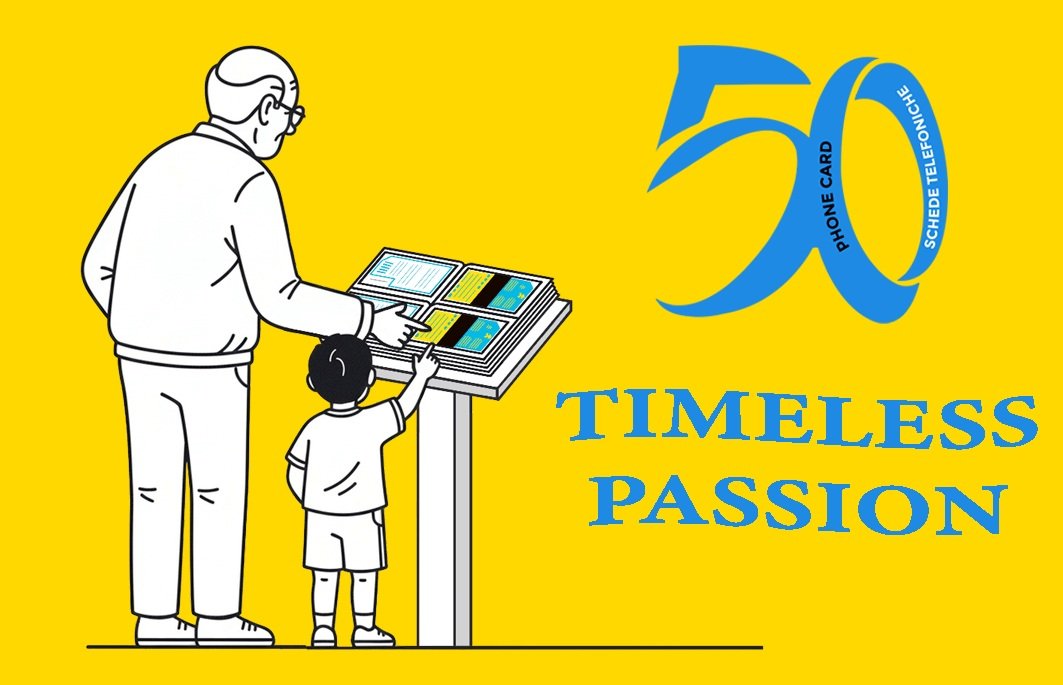
First Place: Timeless Passion – Matteo Pasqual and Christian Martino, 1,174 Votes
The winning project emerged from a collaboration between two people who brought complementary skills to a shared vision.
Matteo Pasqual conceived the idea: the generational transfer of a passion for collecting phonecards from grandfather to grandson. In the design, an older collector guides a young child through an album of phonecards at a display stand – a scene that captures the essence of how the hobby has always been transmitted, not through institutions but through personal connection, family and friendship. The image is both nostalgic and hopeful, looking backward at a tradition while projecting it forward into the future.
Christian Martino, a very young graphic designer, translated this concept into the visual form that collectors voted for overwhelmingly. The result – the Timeless Passion design – struck a chord with the community precisely because it goes beyond aesthetics. It tells a story that every passionate collector recognises: someone, at some point, introduced them to the hobby. That person is in the image.
The contest results gave Timeless Passion 1,174 votes, comfortably ahead of the other finalists. The community’s choice was clear.
For production, the background colour of the design will be modified slightly to gold, and the central logo will be replaced with the official logo for the 50th anniversary of the phonecard, which has been registered as a trademark with the relevant Ministry.
Prizes for the winners:
- Matteo Pasqual receives a free WPC Club membership for 2026 – and, as the 21st registered member for 2026, he also receives Membership Card 001, the first card of the entire numbered series.
- Christian Martino will receive a special prize at the PIM 2026 fair. We hope he too will become a passionate phonecard collector.
Second Place: Cristofaro Gozzolino, 728 Votes
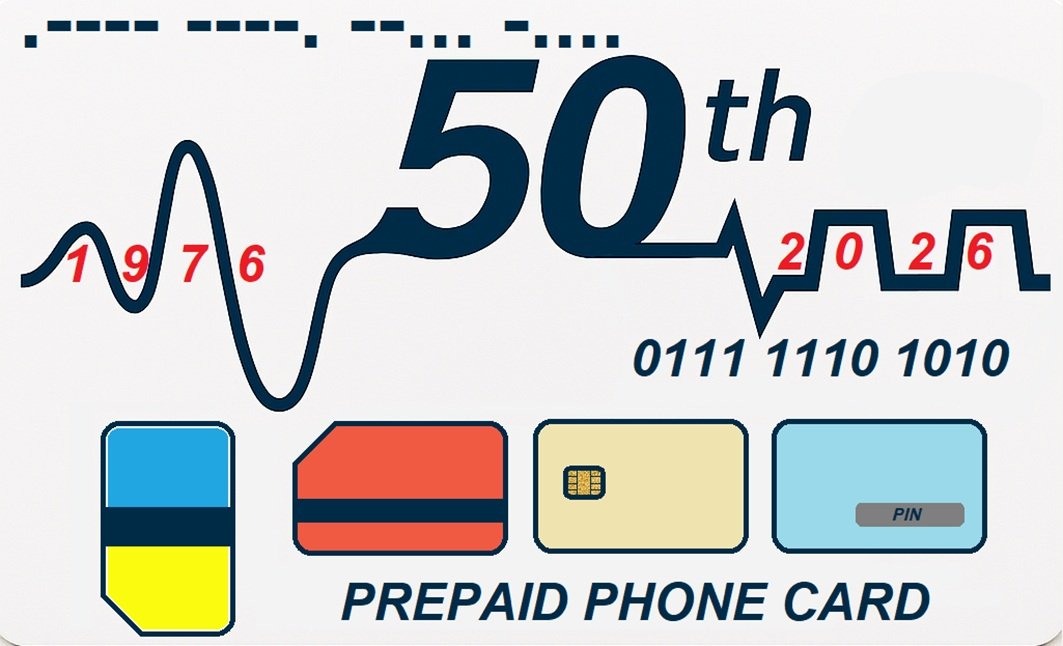
Cristofaro Gozzolino’s project came in second with 728 votes. Where Timeless Passion told a human story, Gozzolino’s design took a different approach: the evolution of the phonecard as a technological object, rendered in a minimalist and technical visual style.
The design is rich in detail for those who know how to read it. The year 1976 is encoded in Morse code along the top of the card – a reference to the year the first public phonecard was introduced in Italy. The binary string 0111 1110 1010 represents 2026, placing the 50th anniversary at the centre of the card through the language of digital systems. Below, a schematic overview maps the principal chip technologies used in phonecards over the decades: from the early optical cards to magnetic strips, integrated circuits, SIM and PIN systems.
The result is a card that works as both an aesthetic object and an educational document – a compact timeline of phonecard technology disguised as a design. The community recognised its intelligence with 728 votes, placing Gozzolino solidly in second position in the contest results.
Third Place: Federico Peluso, 259 Votes
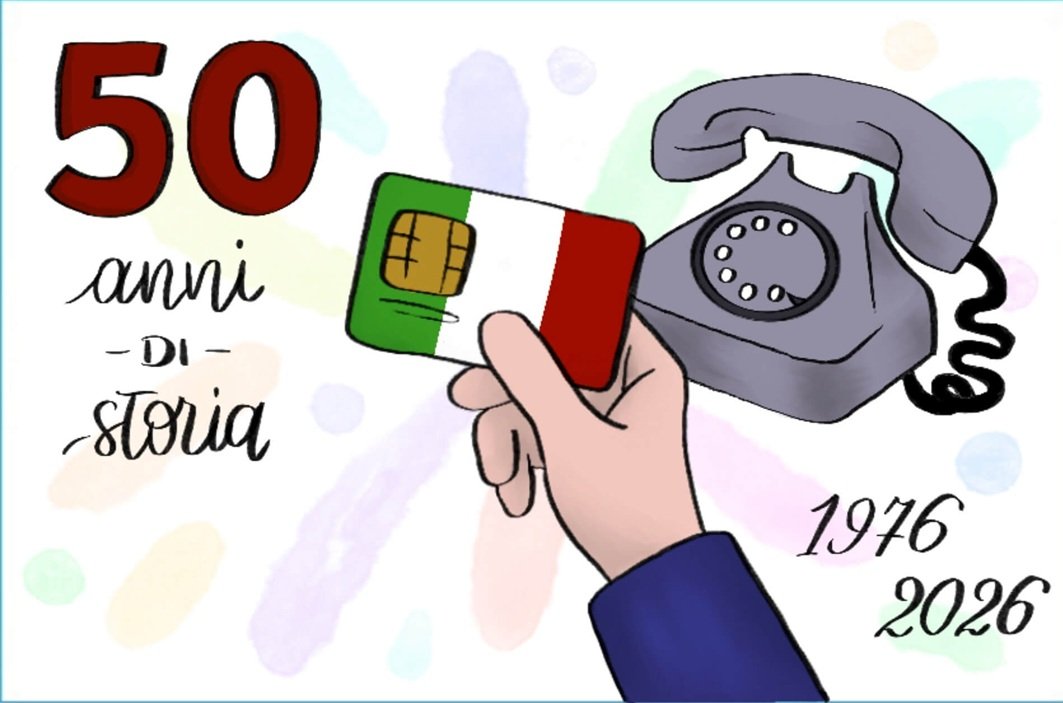
Federico Peluso came in third with 259 votes. His project approached the 50th anniversary from the angle of cultural and emotional heritage, with a hand-illustrated style that sets it apart visually from the other finalists.
The central image shows a hand holding a phonecard with the Italian flag colours – a direct reference to the Italian origin of the first public phonecard in 1976. A vintage rotary telephone occupies the right side of the design, representing the era in which phonecards were born and the public telephone infrastructure they were created to serve. The dates 1976 and 2026 anchor the composition, and the phrase “50 anni di storia” gives the design its emotional register: fifty years of history, held in the hand.
Peluso’s design placed third in the contest results with a strong vote count, demonstrating that the community responded to its warmth and illustrative character even if the other projects ultimately gathered more support.
All 12 Finalists: A Community of Designers
Beyond the podium, nine other projects reached the final phase of the Contest Membership Card 2026 and were presented to the community for a public vote. The complete final standings, including all twelve designs, are available on the dedicated contest page.
The twelve finalists were: Matteo Pasqual + Christian Martino, Cristofaro Gozzolino, Federico Peluso, Tronaru (3 designs), Chaumier (2 designs), Poli, Wisniewski, Cogo and Prampolini. The fact that some participants submitted multiple designs reflects both the open format of the contest and the creative investment that the community brought to the challenge.
Every finalist contributed to making the contest results a genuine collective expression. The range of approaches – from the emotional to the technical, from the illustrative to the minimalist – demonstrates the breadth of perspectives that the phonecard collecting community holds about its own cultural heritage.
For those who want to explore the deeper history of phonecard design and collecting, the Phonecard Museum – the WPC Club’s official cultural partner – is dedicated to preserving and documenting the heritage of phonecards from around the world.
Thank You to All Participants and Voters
The WPC Club wishes to thank all twelve finalists for their creative effort and commitment. Participating in a public contest of this kind requires courage: presenting a personal creative vision to the judgment of an entire community is not a small thing. Each project enriched the contest and offered the community a different way to imagine what the Membership Card could be.
A particular thank you goes to all the voters who took part. More than 2,000 votes is not just a number: it is a measure of the community’s engagement and of the care that WPC Club members and supporters have for the association and its symbols. The contest results exceeded every expectation, and this participation is the best possible confirmation that the WPC Club is building something meaningful.
What’s Next: A New Contest on the Way
A new creative contest will be available soon. The WPC Club is committed to making creative participation a regular feature of club life, giving members and the broader collecting community an ongoing opportunity to contribute to the association’s identity.
To receive all updates about upcoming contests, membership benefits and WPC Club activities, join the WPC Club or ensure your membership is active for 2026. Members are always the first to know about new initiatives and the first to be able to participate.
